
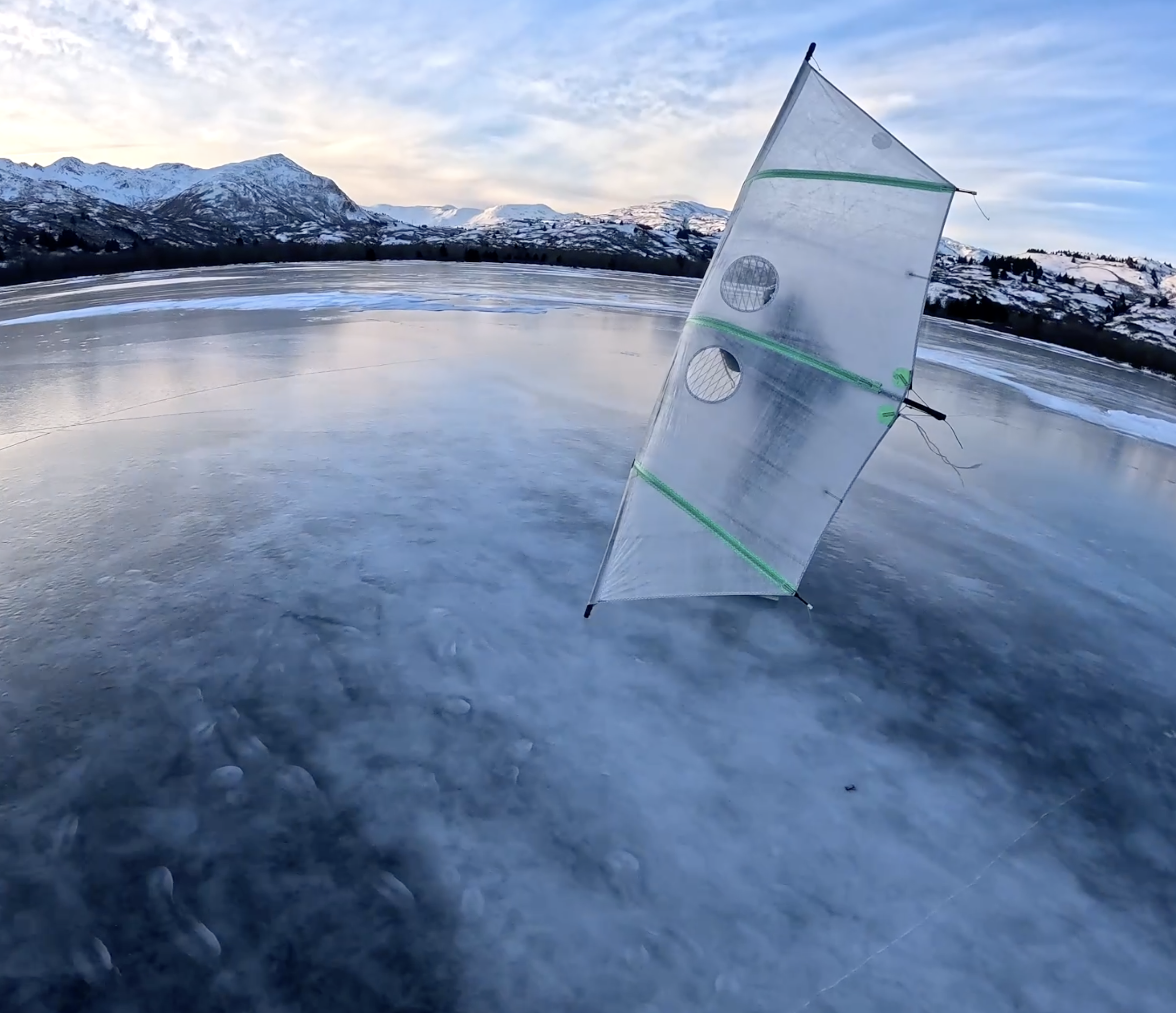

American Skimbat 4.5 SUP Skate Sail
American Skimbat 3.2 SUP Skate Sail
Skate Sails DEC25
Ice sailing is not all about ice boats.
Its about skate sailing as well. If you can slither, slide or ride, you can use a hand held wing to propel. Skating, skiing or rolling, just a different surface. If you can ski you can skate.
Lightweight down hill ski boots and releasable bindings are recommended.
More about skate sails.
All hand held wings work well. Some rigs are designed to be carried on a pack, some are not.
Inflated rigs require a pump. The pump must be carried if you plan to inflate a rig away from the pit area.
Hard rigs may be more complicated to assemble but they can be portable on a touring pack.
Hard rigs are more durable with a longer service life than inflatables by far. Hard rigs are likely to be more efficient, capable of higher performance.
Traditional Kitewing designs are heavy, they are not portable on a touring pack.
Inflatables are bulkey to carry with all the rest of the gear on a pack, dont forget the pump.
Skate sails built from Dyneema fabric epitomize light weight material designed to perform in the widest range of conditions. Light weight is a quality related to performance. The lighter a wing is, the easier it is to fly at lower wing speeds. Carbon frames and battens are crucial to saving weight.
Portability is important. If you are hiking to a lake or skating a large lake you will want to be able to take your rig apart and carry it on a pack. Set up and take down should take less than a few minutes with gloves on.
Skating and sailing ability make a difference. Sailors will want a hard rig where beginners dont care. Touring sailors will want a rig which is easy to carry, set up and break down.
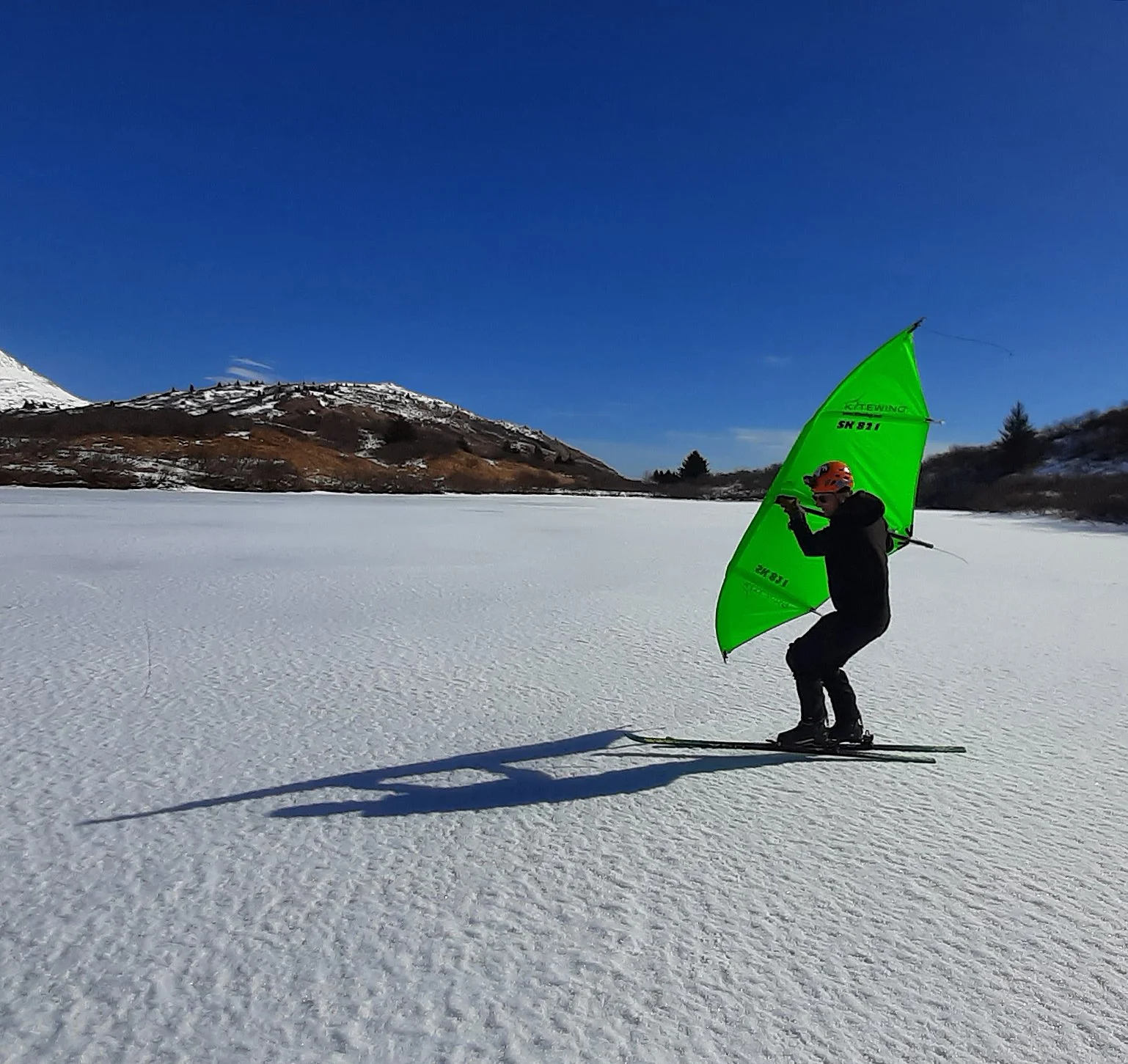
Kitewing SK821 Skate Sail
About 2.2 meters of sail area, 4.25 lbs. Dacron sail. Three Kitewing RBS Skimbat battens. Rolls and stows to about 49 inches.
Kitewing SK821 upgrades the Kitewing SK8 skate sail. Both rigs share the same frame dimensions and parts so components can be upgraded. SK821 uses battens to stabilize the sail.
SK821 is a simple rig with the ability of high performance. Camber can be tuned through a wide shape. Outhaul adjustment and front tube tension can be tuned.
SK821 is relatively soft so it works well enough in a modurate breeze. In heavy air the SK821 can be used with aluminum Skimbat battens to make it a passable heavy air performer.


Kitewing Skimbat Skate Sail
Dyneema rig about 3 meters of sail area, 3.25 lbs. Dacron sails are about .75 lbs heavier than Dyneema. Rolls and stows to 60 inches.
Skimbat is a generic name for hand held wing sail. Kitewing has used the Skimbat moniker to brand a traditional 4.8 meter rig and more recently the smaller and much lighter weight Skimbat Skate Sail.
There are three commercial versions of the Kitewing Skimbat Skate Sail. The first Skimbat sails were Dyneema without windows or tack tensioners. There is a Dacron version of the same sail design with windows. The latest Kitewing Skimbart Skate Sails are Dacron sails with tack tensioners, windows, as well as an upgraded leech. The latest leech has less roach so it can withstand higher loads without flutter.
Kitewing Skimbat Skate Sail uses a tapered carbon tube which limits the minimum stow roll. Tapered tubes are softer than un tapered tubes or tip wand rigs. The tapered tube rigs well in light to modurate air. The Skimbat can survive in heavy air, but it is not a premium heavy air wing. Skimbat works best in heavy air with aluminum battens.
Skimbat skate sails work best with RBS glass battens. The RBS batten is flexible enough to allow a wide range of tuned shape. However the RBS battens are less forgiving, they can invert in heavy air if the wing is mis handled. Aluminum battens do not invert.
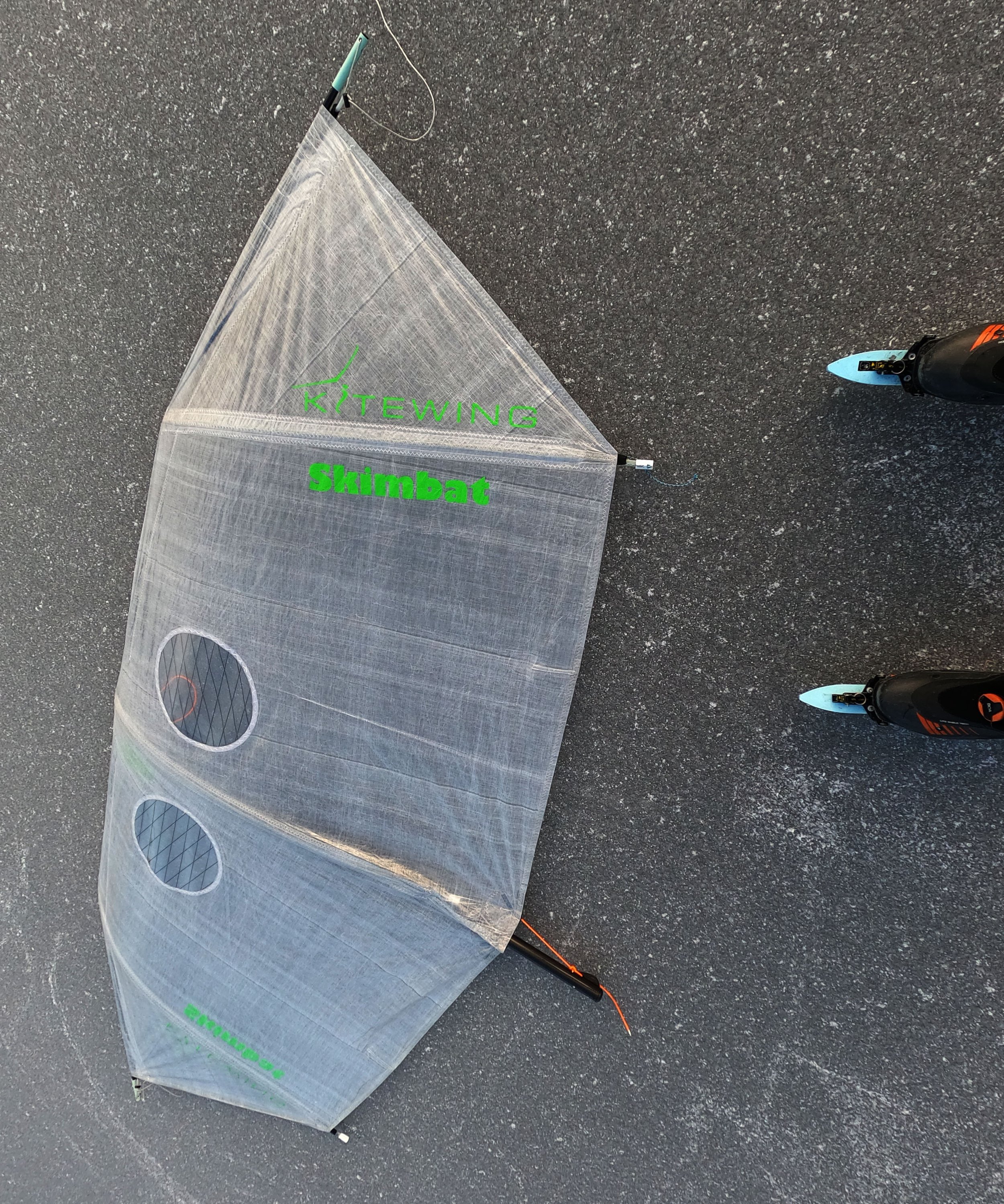


Kitewing 2.4 TW
2.4 meters of sail area, three RBS glass battens, 4.5 lbs. Rolls and stows to 50 inches with 8 degree V tube. Uses standard Kitewing 44 inch Skimbat battens. The production KW 2.4 TW is a Dyneema sail.
Kitewing 2.4 TW was designed to replace the Kitewing SK 821 Skate Sail as well as take advantage of the Kitewing frame system, to share booms, V tube and tip wands with the Kitewing 3.0 TW and the Kitewing 5.0 TW.
While the 2.4 TW is relatively heavy due in most part to the tip wands, the rig packs short, the rig is very durable. 2.4 TW is an extremely versatile rig most excellent in heavy air.
2.4 TW can be rigged with a light weight straight boom or a curved boom with Y tubes, which adds about a pound. Y tubes make the rig stiff and the extra control is apreciated by those who have not yet learned to sail without them.
For a season of sailing the 2.4 TW was my go to rig on ice or hard snow. It is still the fastest rig and the best choice for heavy air sailing because the low aspect shorter front tube allows the rig to be manipulated with ease. Less wing span is also a lot less parasitic drag.
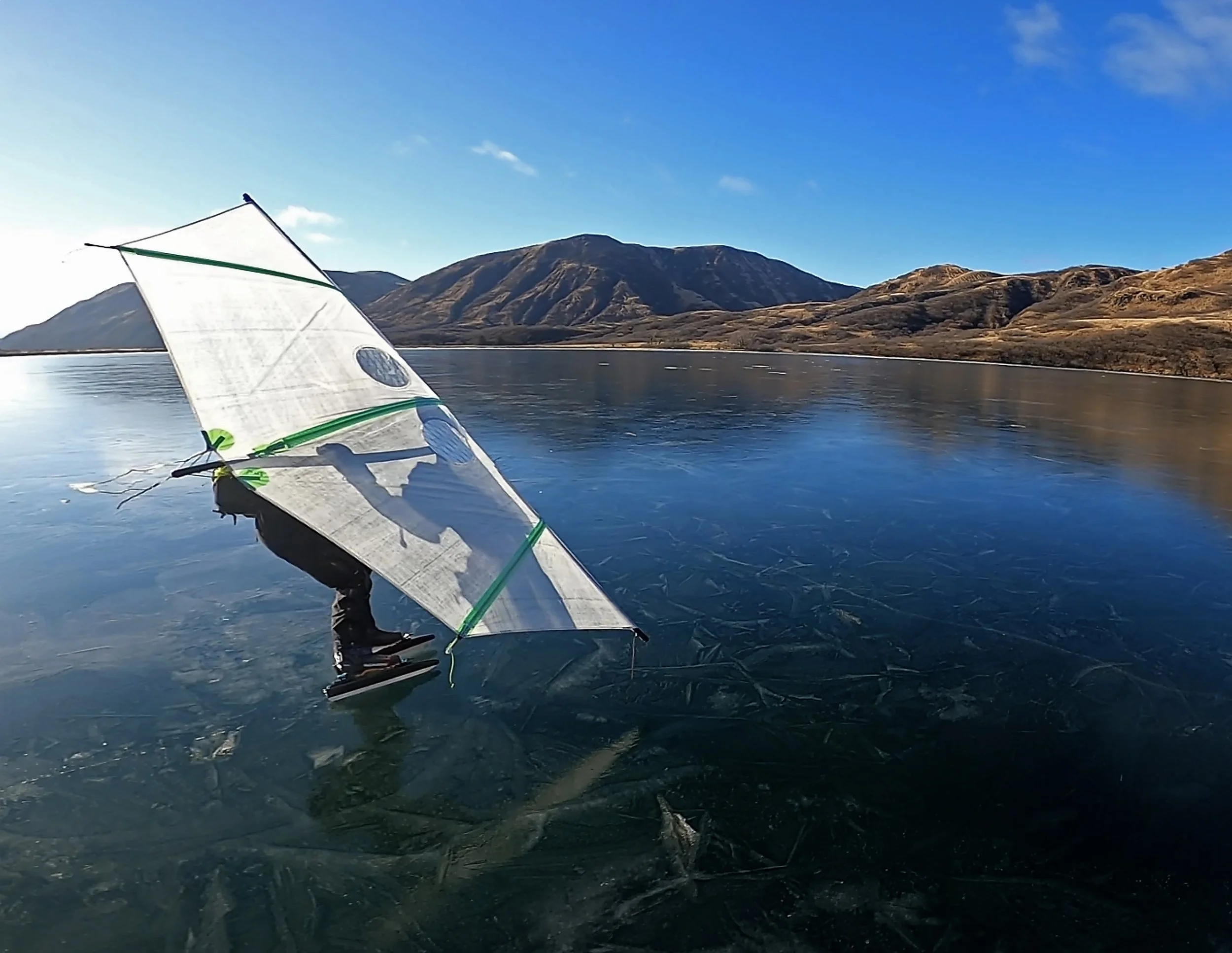
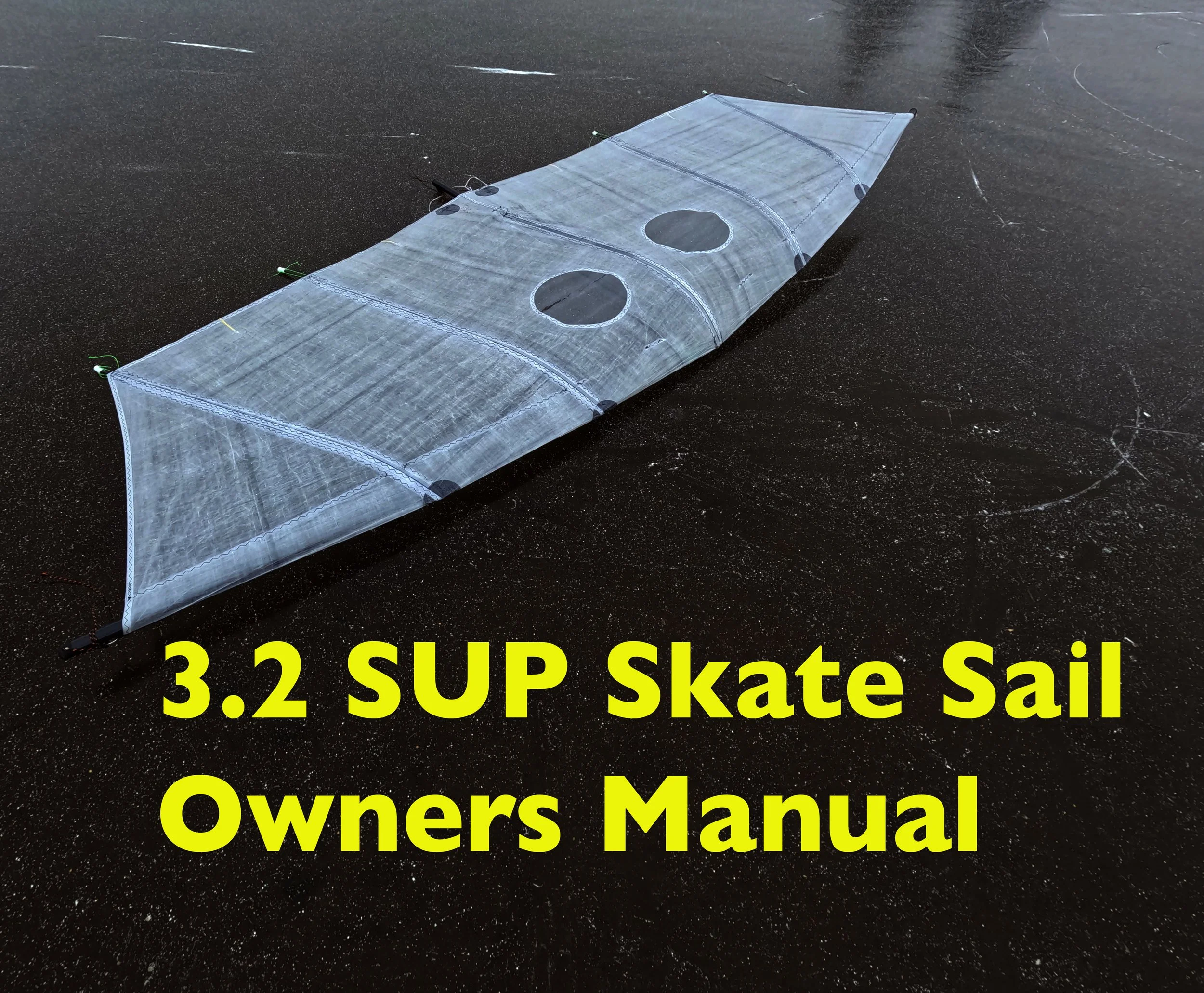
American Skimbat 3.2 SUP Skate Sail
Designed to be easy on an inflatable board, the 3.2 works great on ice or hard snow as well. 3.2 meters of sail area, 4.25 lbs RBS, aluminum or hybrid carbon battens, carbon frame can be rigged with Y tubes and a curved boom.
3.2 SUP Skate Sail is a local favorite at Buskin Lake in Kodiak, AK. A bit more boost in light air than the 2.8 meter rig.

SUP setup MOV at Vimeo
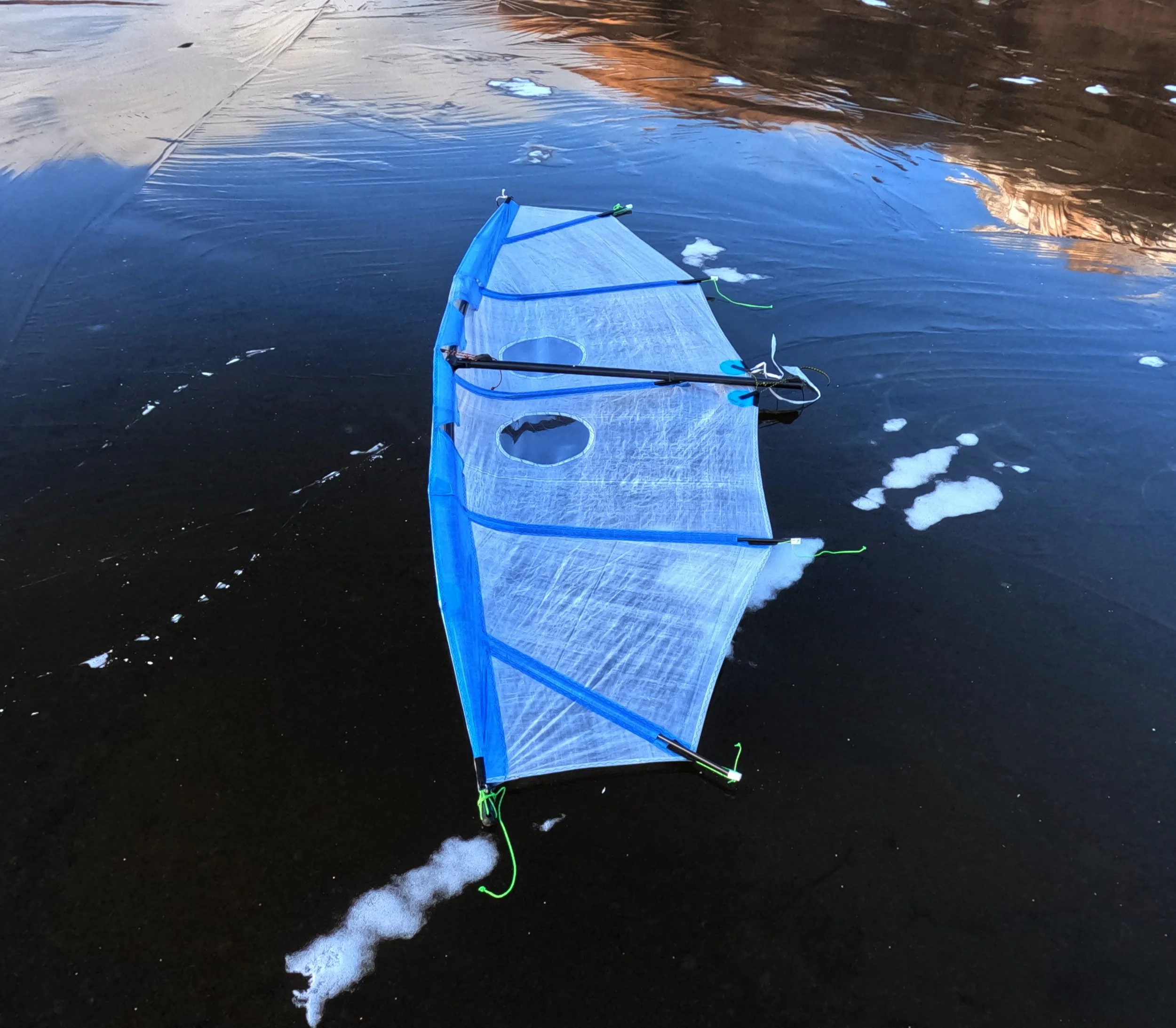
2.8 meters of sail area, five carbon battens, 3.75 lbs. Rolls and stows to 56 inches with 12 degree V tube or 50 inches with an 8 degree V tube. 2.8 SUP Skate Sail cannot be rigged with Y tubes.
I like the 2.8 just about all the time. In super light air I use a 4.5 M rig. The 2.8 holds its own other days.
Five battens give the rig better stability for higher loads and heavy air. Carbon battens are a hybrid batten. The tapered tip of an RBS glass batten built for Kitewing is grafted to a 10mm carbon tube. The carbon batten is quite a bit lighter than all RBS or aluminum choices. Carbon tubes are stiff. The glass tips of the carbon batten allow considerable camber tune which allows a change of shape from full to flat.
All aluminum battens make it tougher to tune the shape of smaller skate sails. However the aluminum battens are easier to rig.
The aluminum battens add a bit of weight to the over all weight of the wing.
American Skimbat 2.8 SUP Skate Sail

2.8 SUP Skate Sail Buskin Lake Kodiak AK Some speed
2.8 SUP Skate Sail NOV 2025