By no means gospel: opinion
Catch as catch can. The blog entries reflect time spent fooling with hand held wing sails. Folks familiar with Kitewing LLC will find much familiar.
The longer we spend with hand held wings the more we learn. Wing designs evolve. Typical progressions include from heavy to light weight, better geometry, easier to handle, more aero dynamic.
Sailing techniques are influenced by the gear.
Along the way there are notes and observations which may or may not be dated as time marches on.


Wing Design
Heavy to light weight.
Higher aspect ratios.
The search for better frame geometry.
How building ideas changes process as practice makes perfect.
What we think we know.
25OCT25
Kitewing LLC no longer offers commercial product. The shop is closed.
Since 2014 we are proud to have designed and promoted hand held wings. We modified and upgraded the original Kitewing. We introduced seven new designs including skate sails.
We pioneered the carbon frame and the use of HMWPE or Dyneema sails. Our carbon frames incorporated custom tapered tube and the innovative V tube which replaced bulky plastic parts.
Kitewing LLC sold what we sailed. We were all about saving weight and efficient sailing.
Kitewing LLC skate sails remain the only skate sail designed to be carried on a pack, the only rig available.
Nordic skaters and skiers who seek to sail need look no further than the pages here for the latest theory and thought. Americanskimbat.com is a resource with links to gear, ice safety, ice advice, and the path to a rig.
Richard Saltonstall

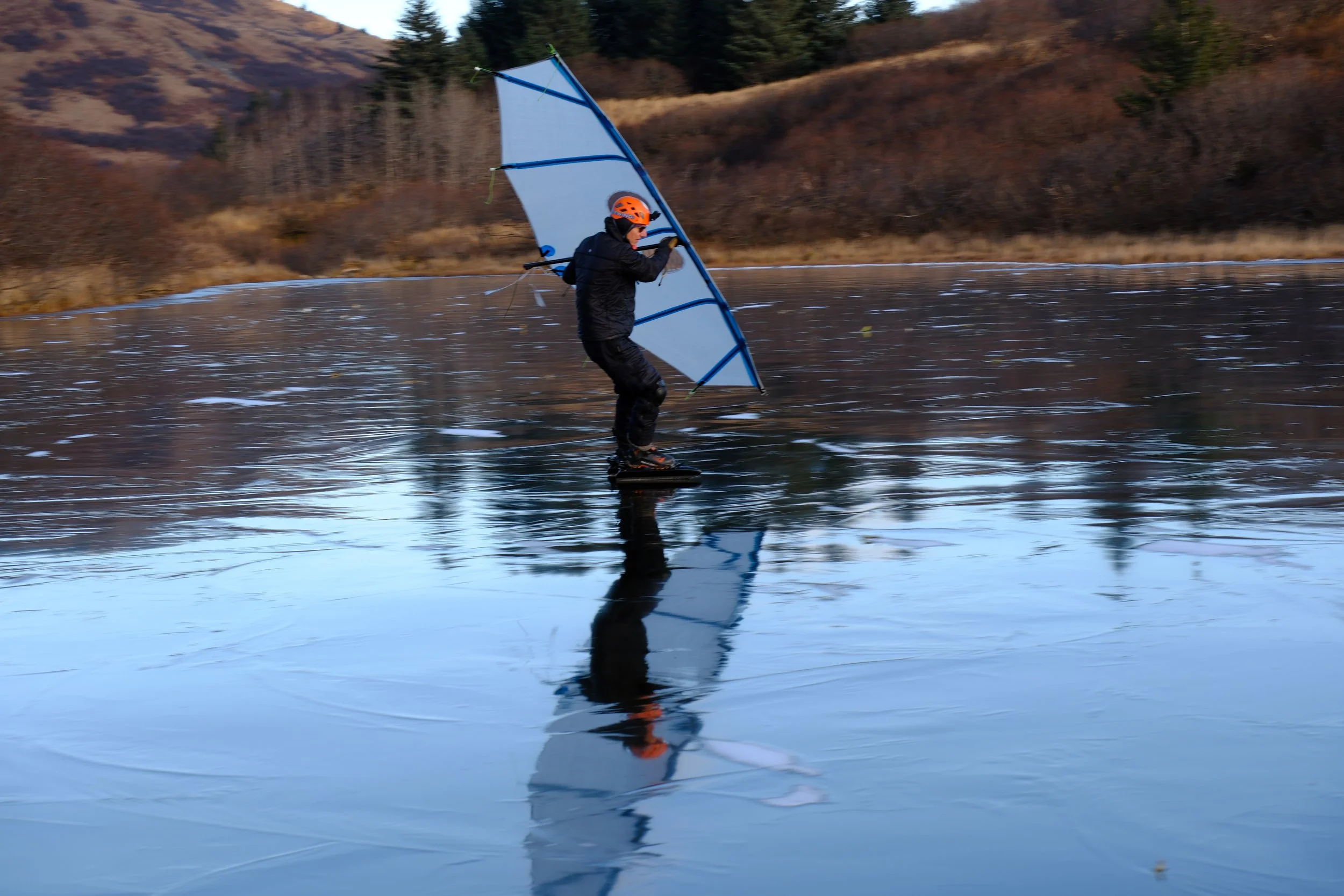
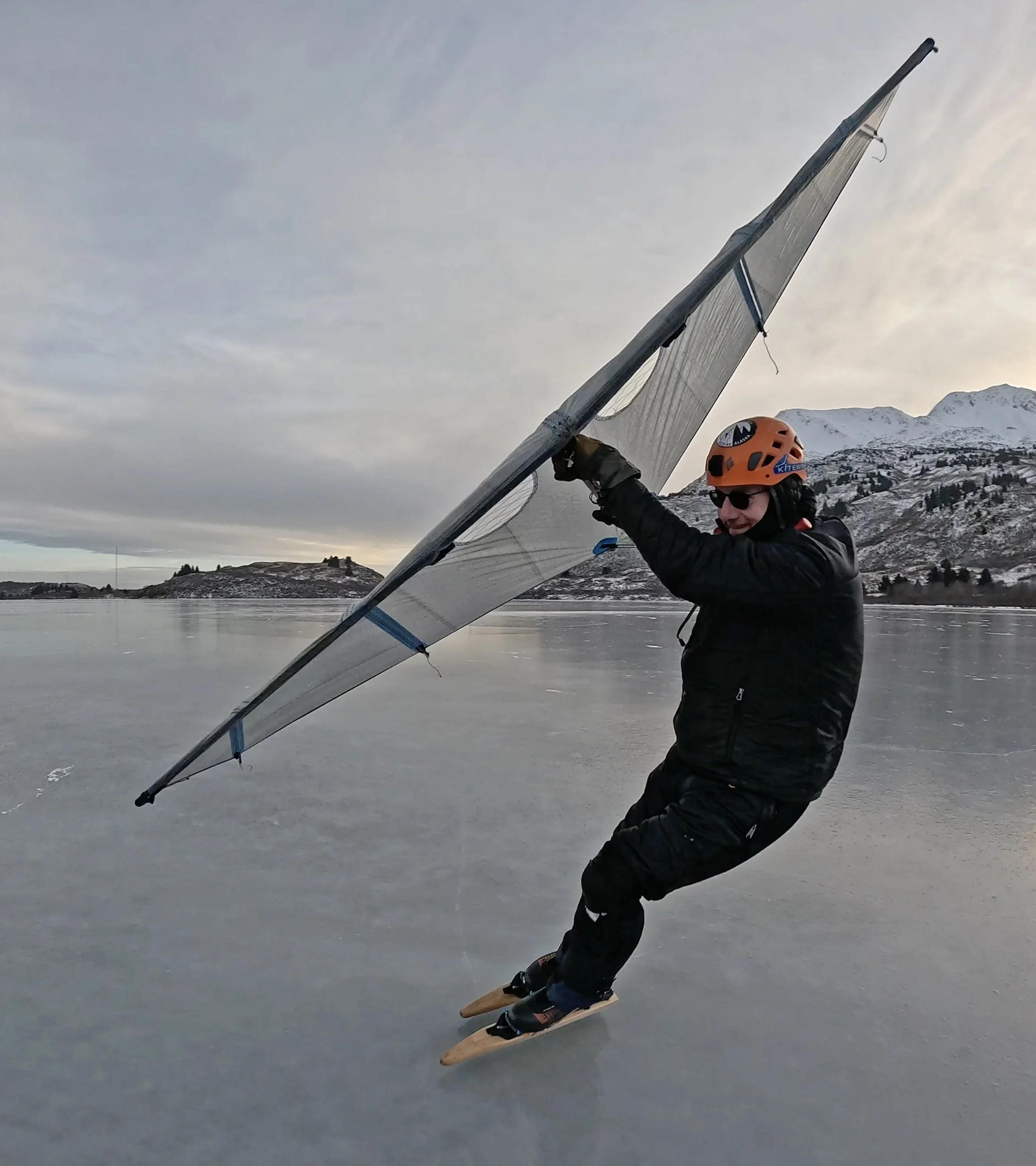
Kitewing 4.0, Lake Lee, Kodiak, AK DEC20
Frames
We have moved away from heavy aluminum tubes. Aluminum tubes are relatively soft compared to newer carbon tubes. Carbon is lightweight and strong.
Saving weight is crucial to wing performance at slow speeds. The slower it flies, the less wind it needs to fly, the easier it is to fly.
The latest frame system is very light weight compared to older traditional frames with cross tubes. Eliminating the cross tube saved weight. Eliminating the nose joint saved complexity as well as weight.
A single boom saves complexity and weight. Y tubes and curved boom add about a pound as well as stiffen the rig. The latest Kitewing LLC frame system can be adjusted for light to moderate wind without Y tubes, or add the Y tubes for easier handling and stiffer frame in high winds.
Frame geometry has evolved to produce a more adjustable frame, a stable wing designed to be easier to fly
Sails
Mylar sails are heavy. Spectra, Dyneema, or high molecular weight polyethylene has changed the game. HMWPE is light weight and strong as well as very durable. Dyneema, Cuben Fiber, Aluula, spectra, are all based on HMWPE fibers.
Sails are much lighter than they used to be. Sail shapes or wing shapes have trended to higher aspect ratios which are more efficient.
Kitewing branded Dyneema sails built at Ezzy Sails in Sri Lanka are very nice. Compared to older Kitewing monofilm or Dacron sails, the average weight saved by Dyneema fabric is about 2.5 ounces per sail makers yard of fabric. As an example: the 3 sq M Skimbat built from Dyneema saves almost 3/4 pound or close to 20% of the Dacron rig.
The stability of Dyneema fabric relative to its weight is unparalleled.
Sail designs do not include any concessions to appearance since extra seams or additional fabric add weight and complexity. Changes to sails reflect a commitment to improve rigging, to save weight and complexity of production.
Rigging
Rigging has evolved with the wings. New wings are more adjustable. RBS fiberglass battens allow an infinite range of camber tune between the camber inducer and tack tensioner.
It is common to see 4:1 purchase at tip tensioners. 2:1 purchase at batten tensioners. Dyneema sails tensioned against stiff carbon frames make the latest rigs less prone to give up shape as loads increase.
Human fingers are quite sensitive, attached to an arm, the sailor of any hand held wing is a living sensor to rival the most expensive complicated array of inert mechanicals designed to control a flying wing. You can feel the apparent wind on your face. If it feels good in your hands, you have it tuned correctly. Folks who take the time to learn the nuances of hand held wing tune are going to sail more efficiently. It pays to experiment.
Design
We respect the older designs but we have not remained mired in an evolution of product development clinging to dated design or sailing style.
It is inevitable. Understanding modern materials is crucial to affect progress. Carbon frames are an obvious example. The same for Dyneema sails.
We sail every season testing new designs and ideas. We sell what we sail. In Alaska we are on the ice from November to April.
Lately we have discovered how much fun it is to go SUP sailing, potentially foil riding on soft water thereby extending our hand held wing time to a year round season.
Designs are influenced by my sailing experience. I am older now, less inclined to jump or fly my wing off the surface. I want to go sailing. I do not want to wait for enough wind. I emphasize light weight. I want to use my rig with cross country ski gear. I want to go touring. I want to sail and have fun on a small pond. I want to launch a board and ride.
Traditional Kitewing OY frames were built to take flying loads with higher safety margins. Kitewing OY marketing emphasized catching air or flying the wing off the surface. We have eliminated the cross tube and the plastic nose joint, thereby saving weight.
Latest Trends
The V tube. We designed a V tube which allows us to eliminate the nose joint. Our V tube can be oriented within the goose neck bracket to change dihedral as well as sweep. the ability to experiment with changes allows us to be more aware of what changing dihedral and sweep does to wing handling.
Less is more. We are exploring the potential of what we call the SUP sail. SUP sail is a simple rig with the same V tube and front tube extensions of the Kitewing frame system. Sails can be rigged with aluminum or RBS battens. The front tube can be stepped to the deck of an SUP or flown overhead. Versatile performance and simplicity define the SUP sail. Tensioners are easier to deal with: there is only one tip tensioner. The tip tension works with thicker chord. The SUP rig is unique.
All the best
Dicky 27DEC25
Which Wing? More Detail 3JAN25
Bigger wings generate more lift with relatively high drag, weigh more.
Smaller wings weigh less, are easier to manipulate with less drag, are faster at top speeds.
Sticky surfaces require more lift.
Fast surfaces require less lift.
The slower it flies its own weight, the easier it is to catch a ride.
Light weight rigs do not require the same full shape as a heavier rig the same size to fly at slow speed. Ergo the light weight flat rig is going to perform within a much wider range of wind because at high speed there will be less induced drag. The flat rig will not buffet or roar when a full rig does.
Top speeds are important to racing sailors. However racing is not just about top speed. Racing is about speed relative to the other racers. Acceleration is important. Distance equals rate multiplied by time. At top speeds the relative difference in speed may not be enough to justify design concessions. A flat wing designed to go fast may not have the lift to fly at slower speeds relative to a full wing which can accelerate or sail faster relative to the flat wing at slower speeds maneuvering on a race course. Full rigs can bear further away down wind.
As far as I know the Kitewing 3.0 Sport remains the fastest hand held rig documented on the planet. Erik Karelfelt 103 kph or 64 mph, Kitewing 3.0 Sport
IMO the fastest speeds we achieve with the hand held wing are not as important as the ability to fly at a walking pace. Light weight rigs which can fly their own weight at a very slow pace are much easier to deal with when the wind dies. Skaters can push a wing along with no effort, power skate, or skate home or continue touring without taking the rig apart.
Stiff rigs maintain wing geometry or stability of shape better than soft rigs. Stable rigs are easier to sail.
Softer rigs do not maintain wing stability which translates to handling issues. However, any hand held wing can be flown over head weather cocked to avoid blustery puff or to survive too much wind. At some point the wind speed might be so high that the wing is easiest to control held by the nose at waist hight with two hands.
It used to be that we advised folks to sail the biggest wing they could handle. Larger rigs flew better at slower speeds, pulled harder, provided the best all around performance. Back in the day we spent a lot of time waiting for more wind. The vintage rigs are heavy, they require more wind to fly.
Today we advise folks to work on technique, be more aware of conditions, sail with the smallest rig which gets the job done. Smaller rigs are easier to deal with. This latest trend may be influenced by lighter weight more efficient smaller rigs which perform within a wider range of conditions. Larger rigs weigh enough to be too much when the wind dies.
If you are an ice skater looking for the premium skate sail with emphasis on light air, Weight and efficiency are paramount.
Sailing on snow is slower, requires a bit more wing, or wind. Waiting for a bit more wind costs nothing but time.
There are inflatables out there with sail areas over 8 up to 9 sq M. Inflatable rigs are soft, produce a huge parasitic as well as induced drag signature, wing weights average about 1 lb per square M of wing area. Based on my recent experience on fast ice in light air, the inflatable did not fly its own weight at the same slow speeds as more efficient hard rigs with less than half of the inflated wing area.
On snow it is important to be aware of conditions. Do not get caught miles from the car with too much rig when the wind dies. Ability to roll and stow to a pack might be important. The inflatable packs to a reasonable size but it is not as easy to strap to a pack as a skate sail which is designed to be rolled and stowed.
While any hand held wing can be handled in heavy air, the bigger the wing is, at some point the big rigs will require an expert wing handler. When the wings get over powered they are harder to manipulate.

Kitewing 6.0 Pro designed to fly early. This rig is vintage now.

Kitewing 5.5 Dacron, lighter than monofilm, full batten set, designed for more lift

More 6.0 Pro at sunset.
Technique
17DEC24
Sailing technique has evolved along with hand held wing design. As wings are much lighter with better shape they are easier to manipulate. Easy to manipulate wings allow quicker maneuvers.
It has always been true of hand held wings, spin the wing like a frizbee to make it change direction. Fly the wing as if it is an airplane.
However the hand held wing is not limited by a fuselage and a pilot who stay oriented with the front to back axis of the wing.
Hand held wings can be manipulated and controlled beyond the capability of an air craft.
For instance: the hand held wing sailor can spin the wing to get it going even while the sailor is moving in a different direction. The best example might be the down wind gybe. It depends on over the ground speed, whether or not speed over ground is more or less than wind speed. Gybe going slower than wind speed and the wing can act like a conventional sail on a boat. Going faster than wind speed, the wing can be directed at flow generated by over ground speeds regardless of true wind direction.
Its possible to run over your wing if you are going faster than the wind is blowing.
Its possible to direct your wing to take advantage of the wind vector while you are going in a different direction in the middle of a gybe or tack.
Airplane pilots worry about stalling. Hand held wing sailors learn to avoid stalls, however, stalling the hand held wing does not risk falling out of the air.
The quicker you can direct your wing to find available flow, the quicker it will start to pull.
Beginners need to be able to find the true wind direction to appreciate apparent wind. Experts need appreciate that there is always something new to learn.
Stiff light weight rigs are easier to pump. The latest SUP sail can be pumped to generate decent speeds on fast ice. Older heavy traditional rigs can be pumped but it is hard to manipulate a heavy rig fast enough to generate much flow.
Easier to manipulate is easier to sail. Easier to sail and you will experiment with technique.

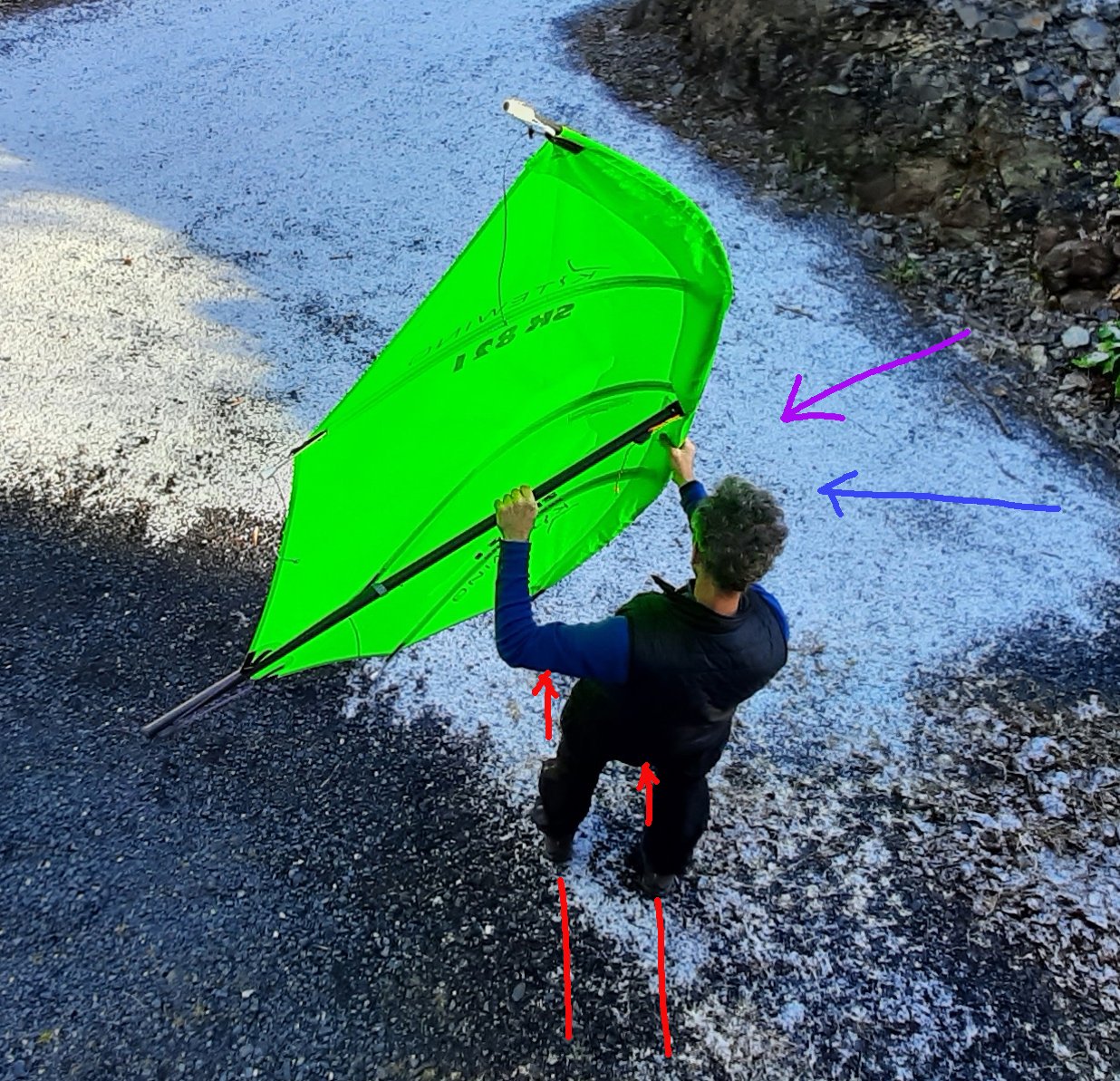
Hold your rig over head. Stand facing the wind. Turn 90 degrees to the wind direction, so the wind is blowing on one side of your face. Grab the leading edge of your rig or the Y tube with the hand closest to the wind, the down wind hand is on the boom.
Red arrows show intended direction of trravel. Blue arrow represents true wind direction. Purple arrow represents combined apparent wind.
Rig is SK 821 with RBS glass battens tuned full to show obvious camber.
Pix is example of static sailing without skates or skis. Practice staic sailing.
Batten Tensioners
Batten tensionbers are counter intuitive. Pull on the inside chord. The tensioner tube acts as a cam to jam the chord against the batten. DEC24

Kitewing Frame System: Booms DEC24
The rig does not need the boom to be installed to support the sail. Booms can be swapped from straight boom without Y tubes to a curved boom with Y tubes. Booms pin to front tube at the nose or tack while snap pins secure the Y tubes.
Sailing without Y tubes is a bit different for those of us who are used to traditional Kitewing hard frames.
Spin the wing to control the wing. The leading edge which is moving ahead will rise, while the opposite edge which is going backwards will dip. Traditional rig sailors all recall the counter intuitive, "Push the boom away to avoid driving the leeward wing tip in to the surface."
Y tubes allow for more forgiving control of the wing. The Y tube is connected to the front tube as well as the boom which permits a more secure one handed grip. With a single straight boom its like riding a bike, the sailor learns where to grip the boom for single handed sailing.
Booms

Carbon fiber skate bodies
25JAN25
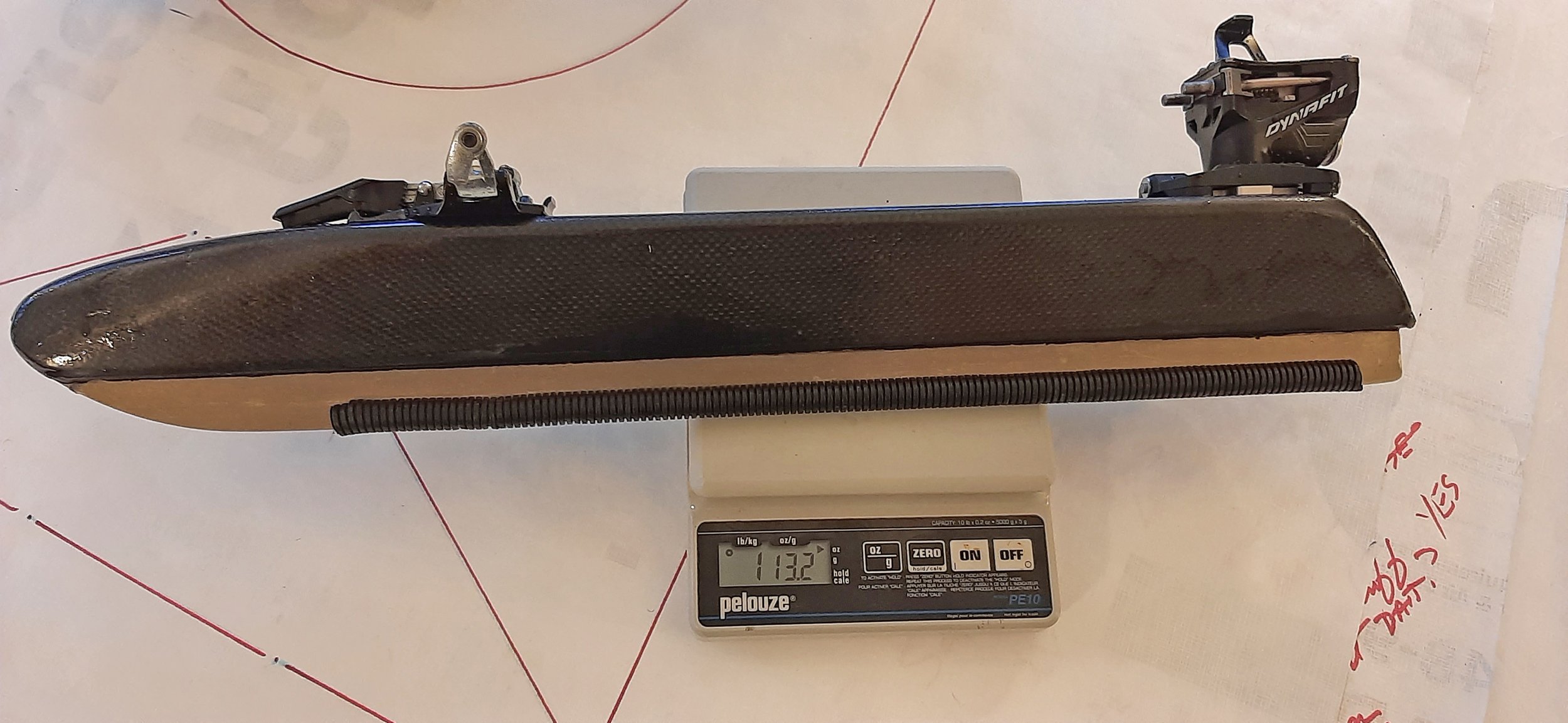
Carbon fiber skate bodies are stiff and light weight. Mine float the blades as well as the tech bindings I use. Safety is an issue. Heavy skates can drag you down if you go through the ice.
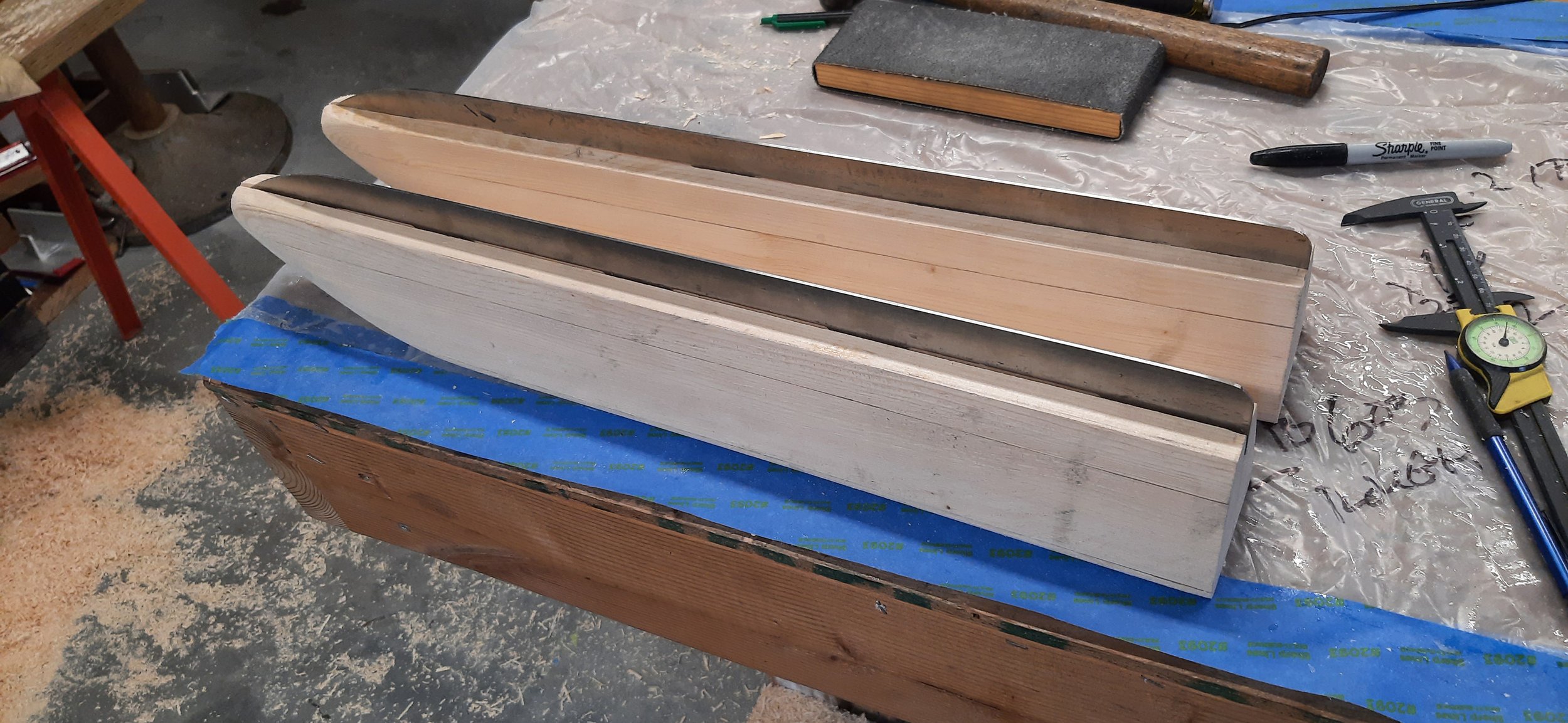
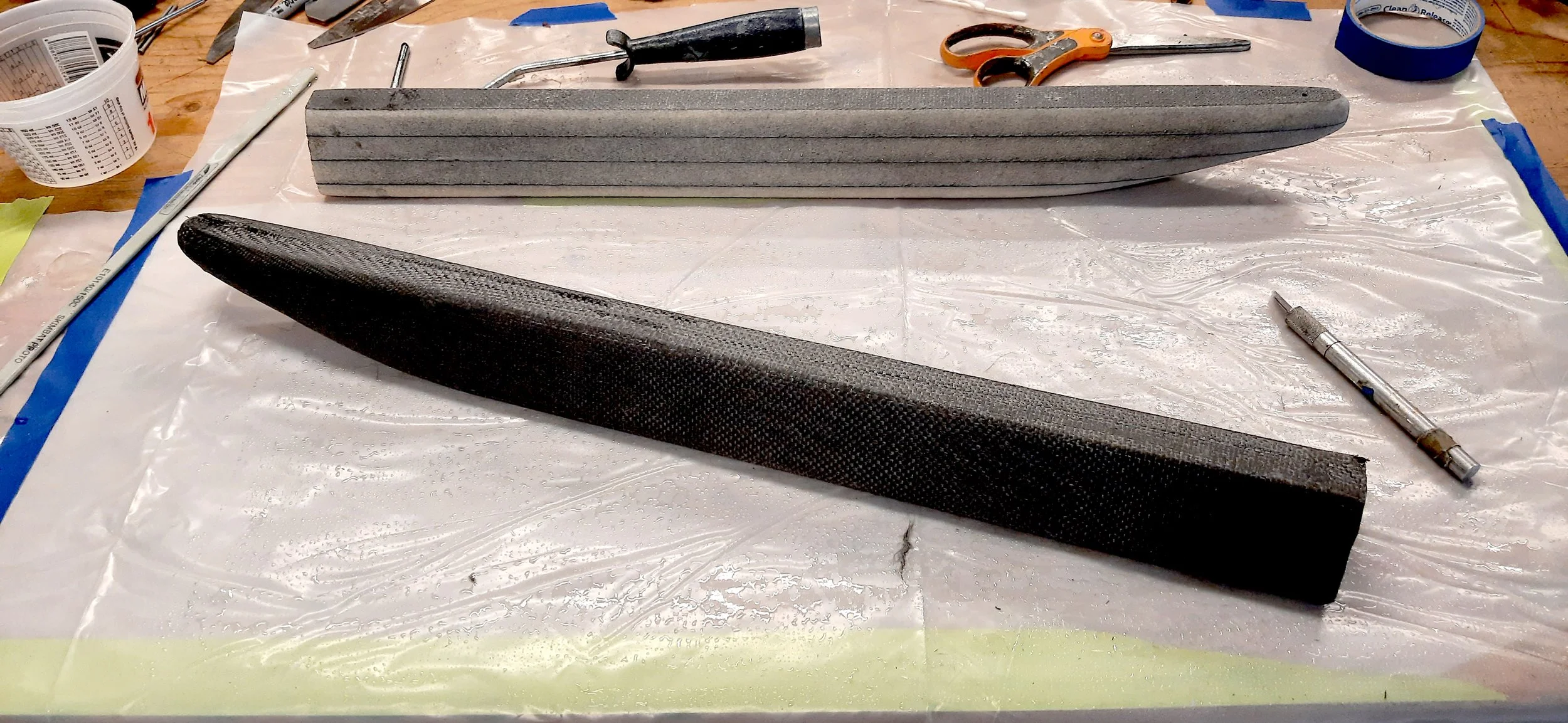
So far building the skate body is a simple job. Blades are Lundhawg 55cm SS which have come out of their original extrusion. We think longer blades are nicer for hand held wing sailing. Stay tuned.
Blade profile as well as blade material are crucial to skate performance. So far the gold standard is defined by the Ermine Williwaw. Lundhawg blades are soft. Ermine Willies are just right, not so hard to sharpen but they hold an edge on clean ice.
More About Skates
Wooden skate bodies
Foam cored carbon skate bodies
NOV25
Skates for Wingsailing
We started out on Nordic skates. It didnt take long to appreciate more support and a releasable binding. We modified nordic skates to use a release plate with a telemark binding.
Telemark equipment has lagged behind the lock down tech binding gear we use back country skiing. The tele gear is heavy compared to the lock down stuff. Weight matters. We switched gear to light weight tech bindings and boots.
Releasable bindings are crucial to save knees. Boot support is crucial to drive longer skates with precision at higher speeds.
Racing sailors who want to be able to lay the skate over to carve turns seek to avoid boot out. When the boot or the side of the skate hits the ice it will lift the blade away from the ice. Hence we see taller skates used at racing events.
Wing Blades describes skates made in Sweden and Canada designed to be ridden higher off the ice to avoid boot out. I believe the Wingsk8t is another version of the same idea. A tall steel blade is gripped by an extrusion or bolted to aluminum angle.
We tried a Canadian version of the wing blade. At the time it was the hot skate. Riding on a pair of Wing Blades was a step up from flimsy light weight nordic skates.
However, Wing Blades are heavy. Even with a releasable binding or a binding set up so it can be released quickly the Wing blade is a liability if an ice sailor goes through the ice. The blades of my wing blades were and an eighth of an inch thick. My Wing Blades had cut outs to lighten the blade but they still weigh 3 lbs. 12 oz per skate without any binding. Swimming with weights on the feet is not so easy.
Nordic skates with tech bindings are much lighter than a Wing Blade but they are not durable enough to withstand sailing loads. Light weight extrusions get bent, blades which are glued to extrusions often pop free.
Ermine Skate tackled the problem to produce the Williwaw skate. Williwaw skates are very nice. A premium blade is pinned and bedded in bedding compound to a beefy extrusion. The Williwaw is still heavy. However we suspect the Williwaw is the best commercially available skate for wing sailing. Williwaw blades are a premium steel. 60 centimeter blades ride rougher ice. With bindings, my Williwaw skates weigh about 2 lbs 10 oz. per skate.
Foam cored carbon re enforced skate bodies have worked very well. The foam core skates rigged with bindings float. Being able to get your feet up to the surface during a self rescue situation is crucial. If you fall in through the ice you will not be able to use your picks effectively if you are not horizontal. If you are jack knifed over an edge because your feet have been dragged down it is very difficult to get back on the surface of the ice. My 60 cm foam cored carbon skates weigh 1 lb. 12 ozs. per skate with binding.
Wooden skate bodies work well so far. My own are built to float. However during the design phase of the wood skate body Scott Carlson float tested a blade and bindings and a ski boot. The Scarpa F1 boot has enough positive floatation to float the blade and tech binding. A 60 cm Williwaw blade without its supporting aluminum extrrusion with an ATK Candy 5 binding weighs about a pound. Ergo the wooden skate body does not have to generate positive floatation as long as it remains attached to the ski boot.
Thick steel blades are heavy. Wide blades drag the ice more than thinner blades. However, heavy blades damp the vibration from rough ice.
Lightweight nordic blades which can flex under load will break free of the ice. Blades tipped over past 45 degrees start to encounter diminishing purchase as the side of the blade gets closer to the surface of the ice. A bump or a frozen lump can lift the blade enough to blow the edge of the blade out of the ice. We believe that a reasonable half an inch of clearance from the ice at about 45 degrees of lean works.
I rarely tip my Williwaw skates far enough to boot out. Guess I am getting old. Willis boot out at 45 degrees. My carbon skates have about half an inch of clearance at 45 degrees, they boot out at 50 degrees.
Sharpening skates. I use a long belt sander which was originally set up to sharpen DN ice boat runners. Most nordic skates are sharpened with diamond stones. While I am betting that speed skaters polish skates with fine grit, I dont think the blades we use to skate and sail require such close attention. Any where from 120 grit on up works fine. Not all steels are created equal. Cheaper skates use cheaper steel. Be sure to de bur edges with a fine 220 grit stone. Do not heat steel by aggressive sanding, you will remove the temper.
A few issues are important. Flat profiles do not skate well. When the contact of the blade with the ice is too flat, any bump or imperfection of the ice surface can lever the flat off the surface. In my experience, a radius or curved contact area described as a radius is what works best. Seems to me about a 28 meter profile or radius works well sailing. If you want to carve hard turns, less radius works better.
The maximum width of the blade to skate deck on my skates is close or at boot center marked on my ski boots. The radius of the blade can be measured against a straight edge. The blade should be able to smoothly rock on a straight edge. Lumps and bumps in a skate edge can be felt. When the skate deck is parallel to the straight edge the blade contact should be around boot center.
Some folks like to use a compound rocker, a skate blade profile with more rocker or an asymmetric curve to the rear of boot center. This allows a skate sailor to lay on the back of the skate during a hard turn, to turn a tight radius with less drag of the blade. Dragging edges is slow.
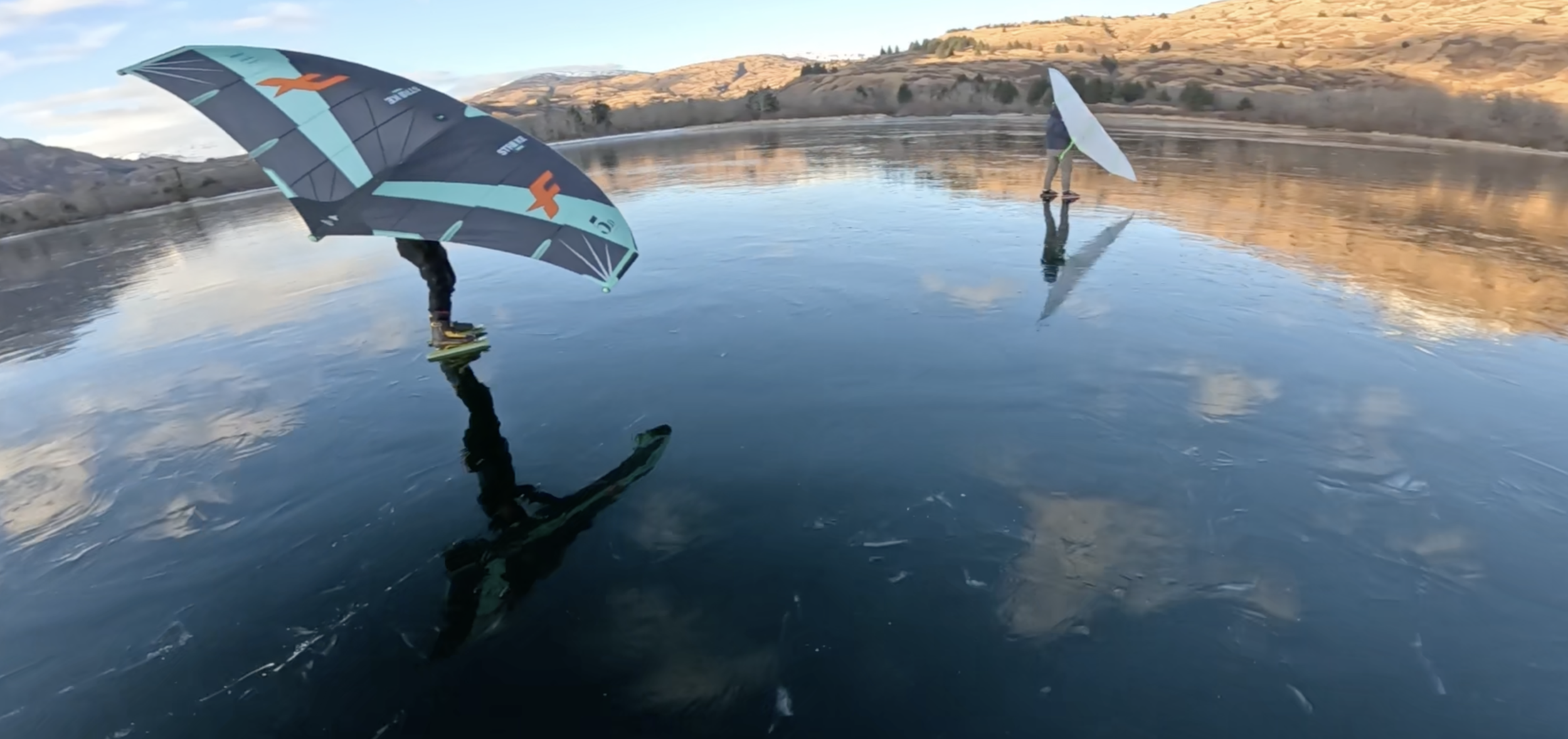
I have had some serious time to compare the inflato to the hard wing. Trials have included all manner of wind speeds from ice to water surfaces.
The inflated wing does not compare favorably. Not enough said.
There is no way speeds will ever be very high with such an extreme inflated drag bucket. Eliminating drag is crucial to high speeds. For instance: the Kitewing 2.4 TW is noticeably slower when it is sailed with Y tubes.
On nice ice in light air, the kind of breeze you can barely feel on your cheek. Our 5.0 inflato never lasted more than five minutes with any test sailor. In my opinion the inflated wing lacks geometry which could allow it to be power skate sailed or scooter sailed, the sort of sailing which relies on a skater to generate flow.
The latest 3.4SUP sail can be flown off one hand very aggressively. The rig can be pumped and power skated with ease compared to an inflated 5.0 wing.
Our F1 strike three 5.0 required too much speed to fly. Handles are located in awkward places. Our inflatable rig cannot be sailed with one hand as easily as the SUP sail with a hard frame.
As light breezes pick up, the inflated rig works well enough. Top speeds are low compared to hard rigs like our own SUP rig or the Kitewing 5.0 TW. If you want to go really fast the Kitewing 2.4 TW is the way to go. Get rid of the Y tubes for a clean rig. Screamer scary speeds with the 2.4.
On the water, from the deck of an SUP, the inflated rig handles awkwardly. It does not flip or rotate or come out of or off the water any better than a hard rig. When the upside down inflato catches a swimming pool full of water it can be tough to deal with. The only favorable quality would be noting that the inflated spar is a nice crutch for geriatric shaky guys like me. Otherwise the hard rig is easier to deal with in all other respects. The wing tips of the 5.0 inflato drag harder on the water than the tips of a hard wing.
Today in steady 10mph or so breezes on the nicest ice, the 5.0 inflato is awkward to manipulate. I know what to do to make it tack or gybe but the rig is to much drag to spin with the same precise handling as a good hard wing. Handles of the inflato are optimized for two hand manipulation. The inflato was slow. Noticeably slow. Smaller skate sails, the 2.4TW and 3.4 SUP rigs can combine apparent to pull more efficiently as they go faster. Beginners did not like the inflatable compared to the 2.4 TW or the SUP. The inflato remained tethered at the pits this day.
The first step with every beginner is to get them to face the breeze, hold the wing by the nose. Let the wing be a weathervane. Watch folks get a handle on allowing a wing to find neutral. The inflated wing has too much affective sweep. Our 5.0 inflato would sashay around or yaw back and forth compared to a much more stable SUP rig. SUP rig is very stable facing the breeze.
29NOV24
Inflato vss the hard wing NOV24
11NOV25
8.0 inflato vss Hard Rigs
0-8mph breeze
Comparing an 8.0 inflatable to much smaller hard rigs.
Its all about the boost and speeds.
In very light air the 3.0 Skimbat skate sail was on par with the 8.0 inflatable. Speeds were about the same. The 8.0 was harder to sail due to extra weight. 8.0 Inflato cannot be power sailed with one hand. When there was not enough wind to get the big wing going, the 3.0 M Skimbat was very efficient. Skimbat sailed with ease when the 8M inflatable had to be nursed, the 8M rig is ponderous.
As the breeze came on, the big wing quickly developed a lot of power. We switched to a nicer hard rig, the 2.8 SUP. Compared to a 2.8 SUP, the inflato had more boost. Of course it does. At a certain speed the inflato had the power. 2.8 could not go fast enough to generate enough lift to pull with same force as inflato a that point of wind, top speeds were relatively slow, less than 20 mph. Big wings generate more power than smaller wings when they start to fly. The 2.8 could out maneuver the inflatable, but it did not pull has hard in light air.
Next up, the 4.5 SUP. The 4.5 M SUP has the boost and power to compare with the 8.0 inflato. 4.5 SUP can partially support the weight of a sailor to enable carve tacks and gybes in a 5mph breeze. 4.5 SUP is able to use light air to generate more pull as it has more wing area. Its worth noting that comparing a hard rig almost half the wing area of an inflatable is salient. The 4.5 SUP skate sail was more efficient and pulled harder at all wind speeds.
I think it boils down to efficiency. If it can fly its own weight at slow speeds, the wing is easier to fly. Top end is limited by drag past a certain point. Until drag is a factor, around 20mph over ground, boost is going to rule the course. Big wings have more boost when they can fly. Small efficient rigs are limited by speeds until it gets past about 20mph when the drag of a bigger wing starts to affect performance.
On a race bike at around 20mph 70 to 80 percent of the total drag is due to aerodynamic parasitic force. The example set by bicycles is comparable to scenarios on ice where surface drag from skates on ice is low. On the water, the surface drag imposed water is quite high. Even foil sailors are relatively slow compared to ice or snow sailors because they experience higher drag factors.
Inflatable wings are not as efficient as hard rigs to be used as skate sails. However, for folks who are not wing manipulators, maneuverability is not a sticking point. For non sailors who are not so concerned with performance, an inflated wing is simple.
On ice and snow, as far as I am concerned the inflatable is not as efficient or easy to manipulate as an efficient hard wing with comparable wing area. Inflatable wing designers have to deal with the relatively soft inflated spars which make handling less precise. A hard frame can be sailed easily with one hand, controlled by slight wrist twist while an inflatable cannot be sailed the same precise way.
I suspect the soft rig is not going to be able to sail as close to the wind as a hard rig. The more efficient hard rig is going to be able to point higher. Its worth noting, I have not raced against inflated wings beyond an informal day.
Conclusions: Inflatables still have some way to go to reach the same efficient threshold enjoyed by hard rigs. I compaired an eight meter inflatable wing to much smaller hard rigs. I think comparing wings with equal wing area, the inflatable would loose every comparison except the weight to wing area. Hard rig wing weight to wing area can be very close, perhaps comparable, but not as light as wing area to wing weight of top inflatable wings.
Skimbat weighs about 3 lbs to 3M sail area. A softer skate sail designed for light air.
2.8 SUP weighs about 3 lbs 12 ozs to 2.8M sail area. A five batten wing designed for heavy air.
4.5 SUP weighs 4 lbs 9 ozs to 4.5M sail area. A five batten rig designed for more boost in snow
Armstrong 8M inflatable weighs 9 lbs. As advertised for light air.
11NOV25
Dicky Saltonstall
4.5 SUP skate sail vss 8m inflatable
9MAR26
A CONUNDRUM OF WING
American Skimbat Makes a Case
I dont understand why racing sailors have not embraced the hard wing.
Is it because inflatables are easy?
Is it because the best reference is the heavy antique Kitewing?
Is it because there is no suitable hard rig available?
On a windy day you can unzip your coat at the top end of a pond increase your own sail area and blow to the down wind shore. Wing shape, drag and weight are the factors which determine performance. From bed sheets and bamboo, to carbon and Dyneema, performance is all about shape, drag and weight.
Empiric experience is the bane of a theorist pundit who may as well be a bull shit artist.
Get past the pundits who insist on traditional design. Pundits insist on Y tubes or preach about battens which will invert or dangerous carbon tubes that break or insist that there is a relationship with hang gliders.
Traditional wing builders, influenced by hang gliding pundits, built heavy hand held wings which are not capable of flying their own weight in light air or easy to manipulate compared to lighter weight inflatables.
Light and easy to manipulate are what makes any wing stand out. Inflatables can fly their own weight at relatively low wind speeds. Light weight is easy to manipulate. Light weight flies.
However, inflated spars rely on dimension and material stiffness to maintain geometry. The inflated wing spar is too bulky to be an efficient aerodynamic element.
Folks have relied on the skate sail for centuries. Light weight simple skate sails work. A simple skate sail derived wing is fast at top speed because it generates less drag. There is no thick inflated tube, extra frame tubes, or an unsupported sail fabric flapping in the breeze.
Simple hard wings derived from skate sails are more efficient fliers at slower speeds than the same size inflatable. It is because strong stiff frames of carbon tube with battens and Dyneema fabric allow for more efficient aerodynamic and adjustable wing shapes.
American Skimbat wings derived from skate sails are more efficient, cheaper, and last longer than the inflated counter part.
Obviously materials have influenced the design of a more efficient wing. Carbon fiber tubes are light weight and strong. Dyneema fabric is light weight and strong. Battens induce better shape.
Foil riders have revolutionized the sport of hand held wing sailing. Water born foils have captivated sailors from Maui to the Mediterranean. Foil riding with a hand held wing has taken the wing sailing sport from a niche of snow and ice sailors to mainstream at the beach on a sunny day.
But inflated wings are not as aerodynamic as hard wings.
Tensioning sail fabric against battens and frame tubes allow the hard rig to infinitely tune or adjust wing shape. Inflated wings are crude by comparison.
Why do racing sailors continue to ignore the simple concept of hard hand held wings which have proven to be more efficient than inflated wings?
American Skimbat SUP skate sails are not designed for racing sailors but they do prove a point. The weight of simple American Skimbat SUP skate sails is on par with inflatable wings the same size. The aerodynamic comparisons favor the hard wing.
American Skimbat has been designing and building wings since the Kitewing 3.0 Sport, the same wing to set a speed record last season, Erik Karelfeld: 64 MPH. At American Skimbat we know hand held wing sailing.
During sailing sessions here in Alaska, inflatables end up languishing in a pit area. Experts or beginners go sailing with what works best. They dont pick the heavy antique Kitewing OY based rig, they dont pick the inflatable. At sailing demo sessions, folks pick the light weight rig which works the best.
At the end of the day, its not the complication of the pump, the bulky pack, or the wing which blows away when you put it down. You use what works.
If you want to play catch, the Frizbee flies better than a beach ball.
If you are a racing sailor who wants to improve, go to Americanskimbat.com and read up.
Its not about theory any more. Heavy overbuilt wings like the traditional Kitewing, including the 3.0 Sport, have had their day. Light weight rigs from the inflatable to higher performance aerodynamic SUP skate sails are here.